Scarface: Al Pacino’s Impact
Directed by Brian de Palma
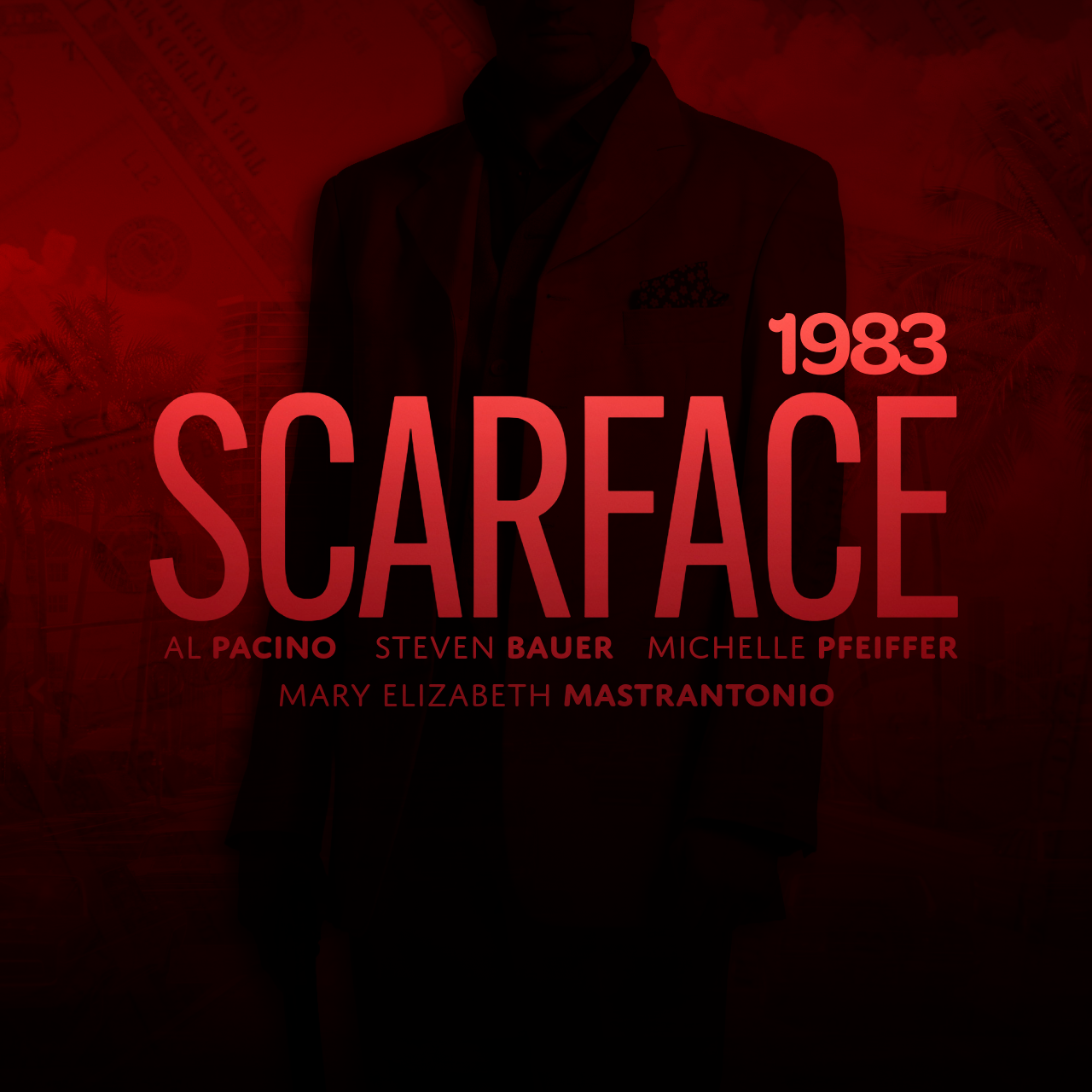
“In this country, you gotta make the money first. Then when you get the money, you get the power. Then when you get the power, then you get the women.”
Tony Montana
Scarface, directed by Brian de Palma, took place around the backdrop of the historical 1980’s Mariel Boatlift where President Fidel Castro allowed an estimated 125,000 Cubans to leave Cuba and trigger a mass migration to South Florida. Martin Bergman, also the producer of Dog Day Afternoon (1975), returned with Al Pacino to craft another classic. The film follows two Cuban migrants Antonio Montana and his right-hand man Manolo Ribera as they attempt to build a name for themselves free from the communist regime of Cuba in the land of the free – United States. In one sentence, Scarface is a cautionary tale of ambition married with greed. It was his ambition that drove him to succeed but his greed became the impetus to his downfall.
Antonio, known as Tony Montana, is embodied by Pacino. Unlike the calm, reserved man we would have seen as Michael Corleone, Pacino is the complete opposite. With a Cuban, sometimes East Harlem, accent that goes in and out, Pacino still manages to create a larger-than-life character. He employs strong acting to portray an unhinged depraved man that takes offense at the tiniest thing. Pacino solidified the film as a classic, with so many iconic references repeated in modern pop culture from a film released decades ago. His side-kick Manolo, played by the only Cuban American on the cast – Steven Bauer, does a great job of being the one that keeps Tony level-headed at times. The supporting characters did a good job, Michelle Pfeiffer’s character fell a little flat but that may be due to the writing.
The storyline was simple enough to follow and the dialogue lacked in some parts. Despite this, Montana has so many memorable quips that still pervade pop culture. There is an extensive use of profanity, along with a few explicit scenes to be wary of. To match the tone of the film, the cinematography is vibrant with neon lights, a classically 80s soundtrack (Composed by the ‘Father of Disco’ Giorgio Moroder), and a bit of action packed into it. Opposingly, many claimed that the film shone a negative light on the Mariel Cubans, however, the film simply touched on a larger issue as to the way these people were viewed in South Florida – which is probably why Tony insisted that one is only respected if you have money, because they were viewed as criminals otherwise.
It is no secret as to why Scarface is such an acclaimed and highly praised film. Fortunately, it has a certain quality to be considered a cinematic masterpiece and one of those qualities just happens to be Al Pacino.

Watch trailer for Scarface.
Available to Rent/Buy: https://amzn.to/3ZJB1oN
(NB: As an Amazon Associate I earn commission from qualifying purchases.)
 The Island Cinephile

What are your thoughts?