The Color of Money: Beautifully shot sequel with little substance
Directed by Martin Scorsese
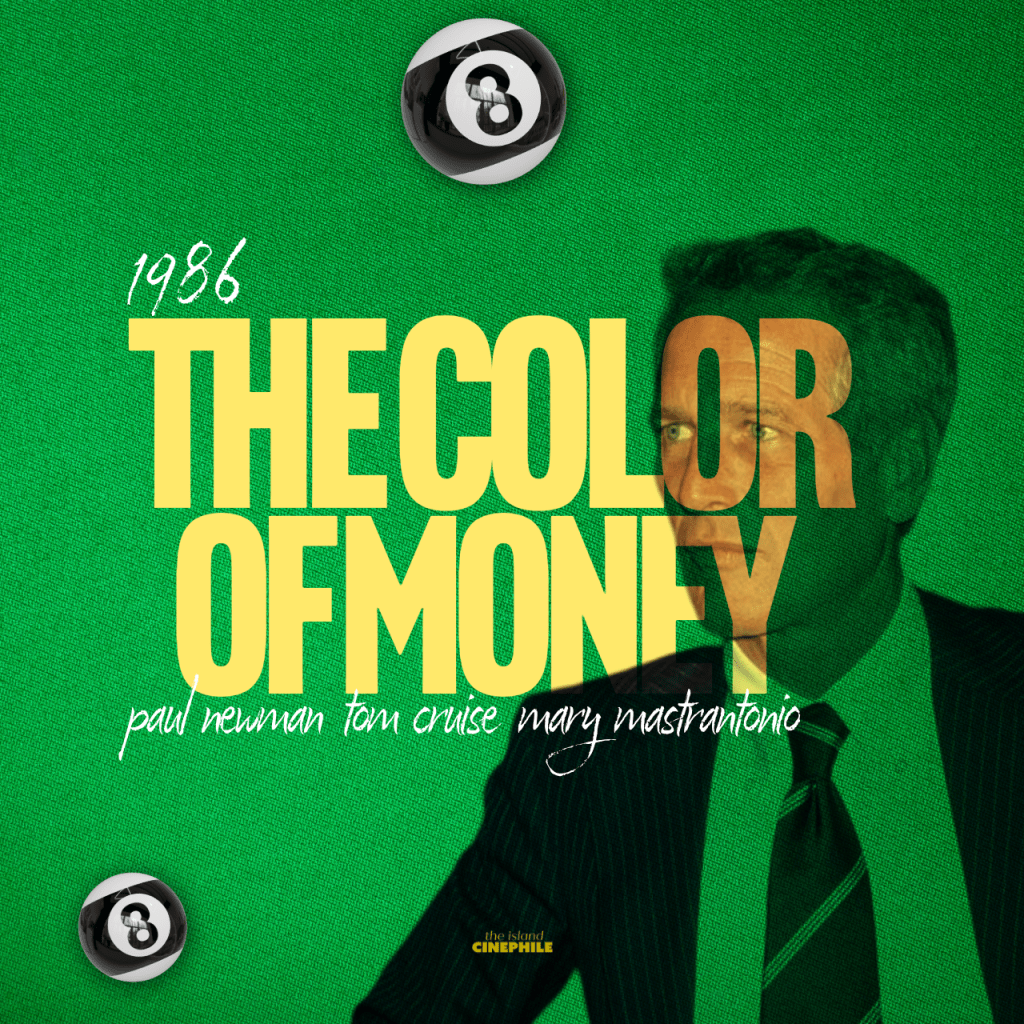
“Money won is twice as sweet as money earned.”
eddie Felson
The Color of Money debuts nearly two decades after the major success of The Hustler. Under the direction of Martin Scorsese, the film is framed beautifully with aesthetically shot scenes. Merely a revamp of the original, the narrative remains but plunges itself into a pond of fresh faces. So it goes, Fast Eddie Felson, the veteran pool player, has retired and runs a bar in Chicago. As a successful salesman in the liquor industry, Eddie fitfully manages other pool players and adopts a Bert Gordon-esque role in this film. The presence of gray hair and crows-feet are expected of a man that has aged physically, yet his true character prevails whenever he is presented with a mimic of his younger self. Vincent Lauria emerges as the audience indulges in the birth of the talented pool player cuffing up the ranks. Supported by the efforts of his coquettish girlfriend Carmen, their hustle proves to be an arduous task. Felson recognizes their play and graciously offers his assistance to Vincent to become a professional. Though Vincent, guided by his impulsiveness, decides to ignore the seasoned player. Resultantly he wins games but loses opportunities, which leaves Felson fatigued by his insolence.
Reprising his role as Eddie Felson, Paul Newman remained the most interesting aspect of the film. Haunted by the mistakes of his past, he tends to employ the naiveté of the younger kids as an opportunity to correct past mistakes. Tom Cruise, a rising 80s superstar in all his baby-faced charm and uncontrolled movements, played Vincent too erratically and void of direction. We never truly understood him or his goals. Mary Mastrantonio portrayed Vincent’s girlfriend, Carmen, as an opportunistically promiscuous girl. Her comportment evinced as one who is ready to leave at just the right moment. A special mention must be given to Amos executed by Forest Whittaker. His character proved to be an interesting one that monopolized any screen time he was afforded, with lasting impressions.
This film prides itself in its ability to stand-alone from the prequel, yet it did not capture my attention in the same way. With similar ratings to the original, I am opposed to the massive appeal it receives. Honing in on character development through dialogue and the use of pool playing scenes as an aid, the prequel sets the standard. By contrast, The Color of Money is littered heavily with pool playing scenes to support the story leaving undefined characters that supply murky motivations. The dialogue, which was crafted by Richard Price, was not as encompassing, leaving it a bit more ambiguous in nature. By the halfway mark, the steam of the plot dissipates and meets its end in disappointment. Most of the confusion of the plot’s direction manifested when Eddie and Vince share a disagreement. Prior to their fallout, Felson retained resolute conviction in executing a “grand plan” that the audience is not privy to. So, one would assume their disagreement seemed to be a byproduct of this plan. In lieu of an ingenious ploy, we are met with a diverging storyline that frustrates the understanding of the film. With such prominent actors, a great director, and artistically shot scenes, it is unfortunate to see it miss the mark.
The Color of Money struggles with finding its own identity as it attempts to balance dialogue, character development and the occupation of playing pool. Excelling on a visual level, the film seems to dull in the most important aspect, which is its ability to produce exceptional storytelling.

Watch trailer for The Color of Money.
Available to Rent/Buy: https://amzn.to/3ZJB1oN
(NB: As an Amazon Associate I earn commission from qualifying purchases.)
 The Island Cinephile

What are your thoughts?