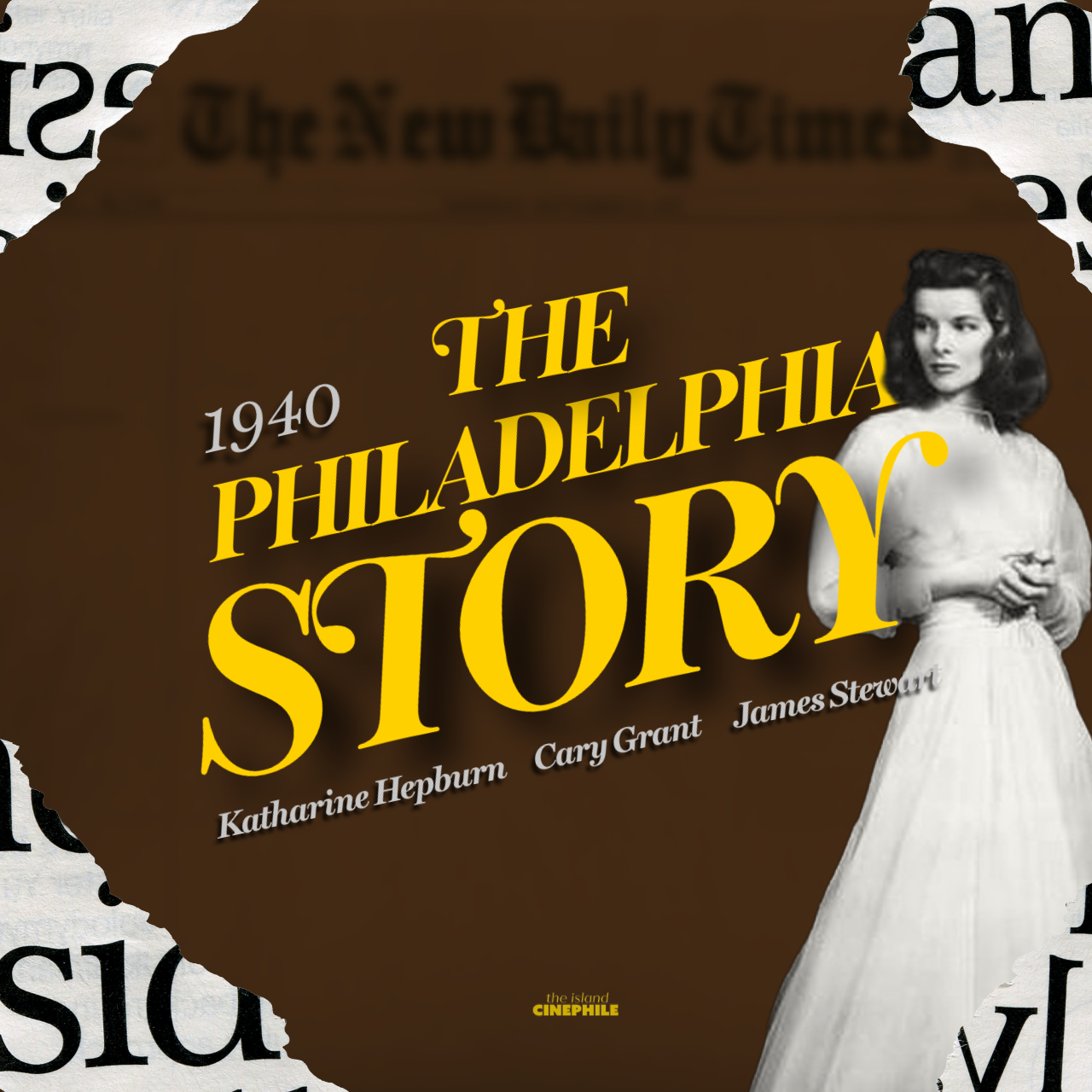
The Philadelphia Story: A classic borne out of pain, on and off-screen
Directed by George Cukor
“The time to make up your mind about people is never.”
Tracy Lord
The defining qualities that prelude the birth of many classic films are hard to pinpoint. Characteristics such as potent dialogue, immersive acting, or perhaps stellar direction could be considered. Though there are many films that have a solid assembly of all three of these, yet something still falters in post-production and audience reception. This is not true of The Philadelphia Story as it boasts in a unique aspect of its triumph.
Inclusive of those aforementioned qualities, the foremost drive behind its success was the negativity directed toward our leading lady, Katharine Hepburn. Let me digress for a moment to detail the plot. Trivial in nature, the premise of the film centers around a wealthy, Philadelphia socialite family by the name of the Lords. Tracy Lord, our protagonist, has all of the unexpressed parts of her life on display. Recovering from a failed marriage with C.K. Dexter Haven, a notable yacht designer, Tracy is set to marry another man of class whom her father respects far more than her ex-husband – Mr. George Kittredge. Their upcoming nuptials are a spectacle for her ex-husband and much of the wider public leaving the publisher of Spy magazine, Sidney Kidd, to request special coverage of the controversial wedding. He uses Haven as leverage who still has access to Tracy; he then uses the name of her brother, Junius Lord, and the philandering activities of her estranged father to gain her permission. Tracy acquiesces to maintain her family’s reputation as she welcomes reporter Mike Connor, and photographer Liz Imbrie onto her pretentious estate.
The characters in this film are so distinct from each other that whenever they appear on screen with their counterparts, a compounding effect occurs. The uppity, close-knit ex-husband, C.K.Dexter Haven, fosters hurt over his lost relationship with Tracy, yet he still protects her and her family from disgrace. He is still loved by the women of the Lord family and utterly detests the upcoming union between Tracy and Kittredge. Portrayed in a gentlemanly fashion, Cary Grant is a wonderful choice for him. Tracy Lord is the bronze goddess – effectually mastered by Katharine Hepburn – according to her ex-husband and her father, both of whom she holds in high esteem. Evidently in her own bubble, Tracy remains avoidant of confronting her own demons from her relationships through quick words and deflection. Seen in a sub-human manner, her plight to be recognized and loved is the impetus of her arc. Macaulay Connor vitalized by James Stewart, is the young reporter that speaks like a poet and lures Tracy in with his words. Connor is not deterred by the pompous display of Tracy’s wealth. In fact, he detests avarice and has summed her up to be a superficial socialite, just like all the others. Her attempt to hide behind this grand estate is farcical, as he eventually sees through this to realize that Tracy has a heart of flesh, not stone. He begins to relate to her as a human, and she clings to him because of this. Both their characters complemented each other beautifully. George Kittredge by John Howard is a bit obscure. His character is given little time with the audience as a direct display of his position in Tracy’s life – temporary. Seth Lord, or Tracy’s father, acted by John Halliday, is misogynistic and unforgiving concerning the publicity surrounding a scandal caused by him. He remains a point of contention for her and the family.
Despite the unpretentious storyline, it flourishes with comedy and an imaginative screenplay by Donald Stewart. With strong performances by each character, there is a fluidity that can be observed. Yet, George Cukor leaves nothing up to coincidence under his meticulous direction. Joseph Ruttenberg shot the film as glamorously as the lives of the extremely wealthy on display with a melodic score composed by Franz Waxman. In reference to the defining quality of this film, we are led back to our protagonist. Outside of the film, Katharine Hepburn faced major failures commercially resulting in a marring of her abilities as an actress. Therefore, to quiet down the noise in the markets, a film adaptation of The Philadelphia Story was borne out of her plight. Hepburn’s monologue and performance in the film are so impactful because similarly to Tracy Lord, her reputation faced major criticism. Pouring her vulnerability into the role, and supported by a stellar cast, even more specifically James Stewart; the narrative was a hit.
The Philadelphia Story proved that it possessed the capabilities to guarantee success with stellar acting, compelling dialogue, and incisive direction. Though, with all these capabilities, the true defining qualities lie in Katharine Hepburn’s vigor – on and off-screen – to redeem herself. Without her, this story may have never had the opportunity to define an era in film.

Watch trailer for The Philadelphia Story.
Available to Rent/Buy: https://amzn.to/3ZJB1oN
(NB: As an Amazon Associate I earn commission from qualifying purchases.)
 The Island Cinephile
What are your thoughts?