To Kill A Mockingbird: Ignorance breeds Unfounded Fear
Directed by Robert Mulligan
“Atticus says cheating a black man is ten times worse than cheating a white.”
Jem
The innocence of youth is underscored by the brutality of adulthood in the fictional town of Maycomb, Alabama. Perhaps it is the narration of the young child that affects the way in which the audience relates to the events taking place. Occurring in a southernmost, heated sleepy town, the ignorance of difference breeds unfounded fear. The patter of feet racing along the grass belongs to Scout, who persistently yells “Atticus” to alert the attention of her father. Atticus Finch is a widowed lawyer who takes care of her and her older brother Jem, and they all live alongside their nanny Calpurnia. During the Great Depression, the people of this town find themselves in a pinch with finances. Establishing the strong moral compass of Finch from the onset of the film, we see how he defends those less fortunate individuals such as farmers and receives payment in unconventional ways like firewood or produce. Meanwhile, his children are constantly up to mischief, and one summer their point of interest is lent to the Radley house. Crafting many fictitious tales about their solitary neighbor, they cower in fear of ever coming face-to-face with him. The kids’ distrust of their reclusive neighbor Boo Radley is juxtaposed to the hostile environment between the whites and the blacks. This alarm of difference is prevalent throughout the town which ultimately produces, death and injustice.
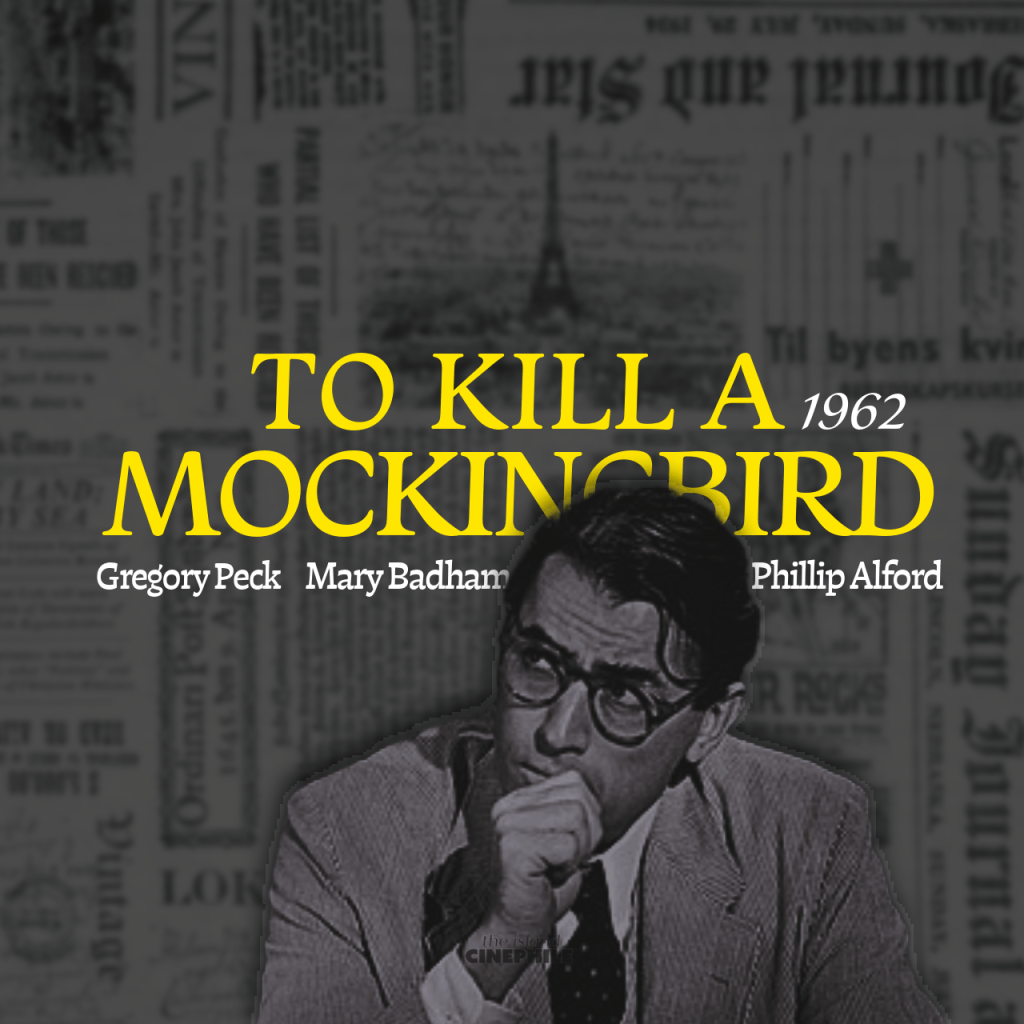
Finch is very much as noble as he is wise, and these qualities, we view of him, are based on his daughter’s perception of him. Rarely do we see him out of sorts, but always in control, even in the face of danger. The role of Finch is awarded to Gregory Peck who does nothing short of remarkable and receives much acclamation for his performance. Mary Badham as Scout is a wild card, whose decisions are majorly influenced by Jem. Phillip Alford’s portrayal of the eldest is presented as one that understands a lot more than his younger sister about the world and looks up to his father. Calpurnia’s portrayal is owed to Estelle Evans who works well enough with that she is given, although it is always heartbreaking to see the little value placed on roles for black artists. Reminiscent of my review of Imitation of Life, I recall how most black actors were rarely given real characters that had real motivations and instead were used to reinforce harmful stereotypes. That’s why it was great to witness the progressivism of Paris Blues, a 1960s film with Diahann Carroll where she develops apart from her white friend and is not merely an extension. Similarly to Evans’ lack of characterization, the accused black man in the story has minimal time with the audience besides when he is on trial. His trial, evidently the talk of the town, is narrated by Scout and in turn the audience garners whatever information about Tom Robinson from a child. This limits the audience’s ability to connect and empathize with a character that is facing a serious plight. Brock Peters portrays Robinson with conviction, but it only goes so far as we know little of him.
Another film that does a great job of humanizing the accused is A Time to Kill which functions in nearly the same way as this one. Yet, our accused has been given personality and character. Jake Brigance, the white lawyer, learns the individual, Carl Lee Hailey, and in turn can defend him much better. Despite these few qualms, To Kill a Mockingbird, is carried by the stellar performance of Gregory Peck. Alongside a great supporting cast, the message of the film is interminable; ignorance often breeds unfounded fear.

Watch trailer for To Kill A Mockingbird.
Available to Rent/Buy: https://amzn.to/3ZJB1oN
(NB: As an Amazon Associate I earn commission from qualifying purchases.)
 The Island Cinephile

What are your thoughts?